Residential care & nursing homes
A dementia-friendly outdoor environment
Text Studo id+Image WHS Media/Merijn Koelink
Taking a walk independently
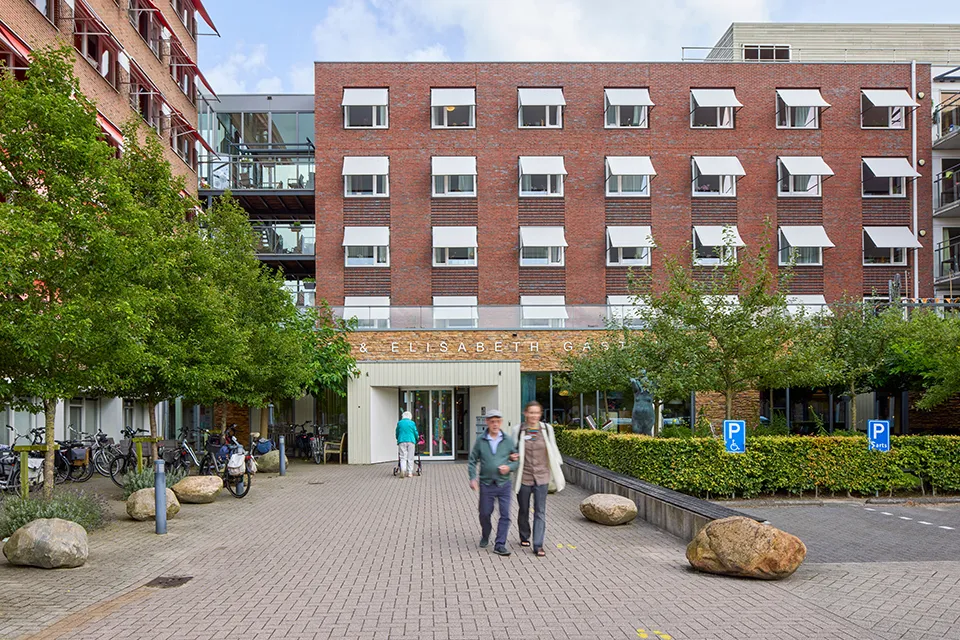
Losing your way, being obstructed by lampposts and having nowhere to stop and rest. When your memory and eyesight are failing, a walk around the neighbourhood is no longer something you can take for granted. Yet a short walk can do people so much good. Commissioned by Gemeente Wijk bij Duurstede and Stichting QuaRijn, and working with Alzheimer Nederland and others, Studio id+ has created a dementia-friendly outdoor environment in the neighbourhood. The pilot is intended not only to make the area accessible to residents of Ewoud & Elisabeth Gasthuis, but also to give local people with dementia a sense of direction in the area where they live. After all, the neighbourhood is an integral part of home.
Urgent need
Wijk bij Duurstede is one of the fastest-ageing municipalities in the Netherlands, and the number of people with dementia, including those living at home, is rising rapidly. Alzheimer Nederland estimates that the number will grow from 320 in 2020 to 850 in 2040. Across the Netherlands, 300,000 people have dementia, of whom more than 80,000 live in nursing or care homes. An estimated 100,000 more people have yet to be diagnosed. Anja Dirks, owner, architect and interior architect at Studio id+: “For people with dementia living in a residential care building, going outdoors independently is difficult or even impossible. There is often a private outdoor area, such as a balcony or enclosed garden, but exploring the surrounding area independently is virtually impossible for understandable safety reasons.”
At the same time, the ‘Drang en dwang’ law, which came into force in 2020, states that residents of residential care buildings should also have as much freedom as possible. For people with dementia living at home, finding their way, even in familiar surroundings, also becomes increasingly difficult. This can make the person anxious and cause concern for family members and informal carers, particularly about safety. Yet going for a walk is so good for people. Jan Kuiper, alderman at Gemeente Wijk bij Duurstede: “The municipality sees the walking routes at Ewoud & Elisabeth Gasthuis as a pilot to enable more people with memory problems to go out independently. This will become even more important with the construction of a second nursing home unit in Wijk bij Duurstede. The municipal handbook for the design of public outdoor spaces will also be updated accordingly.”
An accessible and safe neighbourhood for everyone
Stichting QuaRijn took a broad view of the urgent need and explored how residents in an institutional care setting without an enclosed garden could still go outdoors. It looked at how they could initially take a walk in the neighbourhood with support, and what forms of assistance could enable residents of care facilities who are able to do so to walk independently. Studio id+ was asked to find ways for people to walk safely through the neighbourhood from Ewoud & Elisabeth Gasthuis, while also giving the municipality practical guidance on making the area more accessible and welcoming to people with dementia. The municipality and QuaRijn also want to make it normal to encounter people behaving in a confused manner on the street. It is important that these encounters are handled smoothly and safely. As well as care provider Stichting QuaRijn, Alzheimer Nederland and other stakeholders contributed to the research and commented on the findings through a user group.
A specially developed research method
Before starting the design work, Studio id+ developed a bespoke research method. Four levels, accessibility (physical), spatial (support), social (awareness) and digital (technology), provide insight into how people generally find their way around outdoor spaces and what support can help. Dirks: “As well as mapping physical features that can create barriers, such as kerbs, changes in level, gates and contrast, we also looked at which ‘markers’ could help people find their way. We also considered how domotics and awareness in the neighbourhood could best support someone with dementia.”
A safe walking route
Based on its research, Studio id+ was able to offer recommendations and design a dementia-friendly route through the neighbourhood, from the main entrance of Ewoud & Elisabeth Gasthuis to the centre of Wijk bij Duurstede. Various changes have been made along the route to help residents of the care home and local people with dementia and other memory problems find their way and navigate, and to make the neighbourhood safer. The different options and the final route were also tested with residents. QuaRijn, as a care provider, is committed to supporting residents’ learning and enabling them to walk the route independently in due course.
Striking yellow footprints
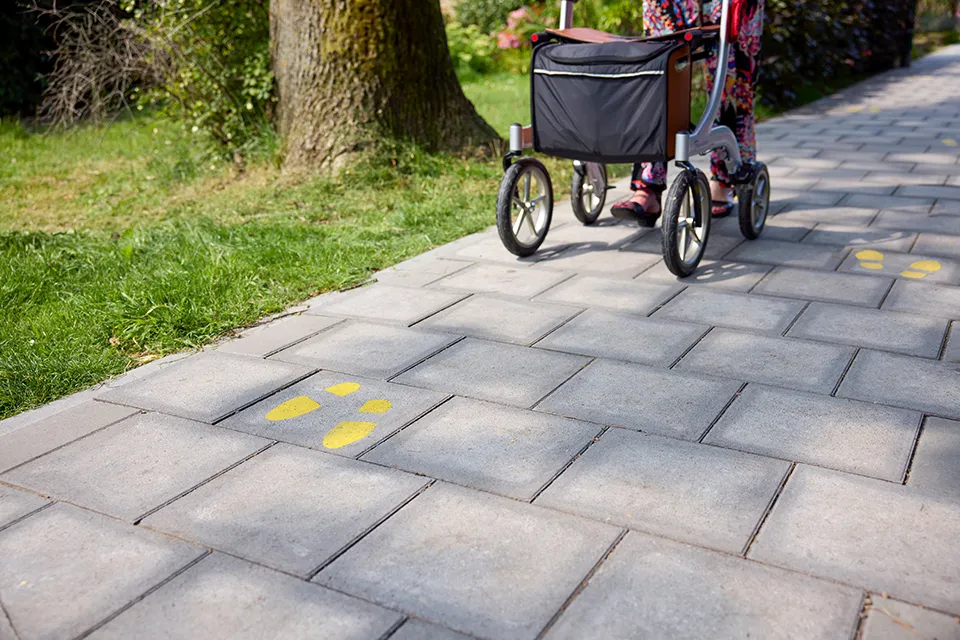
One of the design measures intended to encourage people with dementia to go for a walk independently is the striking yellow footprints leading from the entrance of Ewoud & Elisabeth Gasthuis to the town centre and back. “Many older people with dementia orient themselves by looking at the ground, so they will follow the footprints. Following a route is, in any case, part of how we orient ourselves.” As well as marking the route, the footprints make the care home entrance more visible. Their yellow colour stands out in the surroundings and is also easy to see for people with impaired vision, which often accompanies dementia.
Changes to street furniture
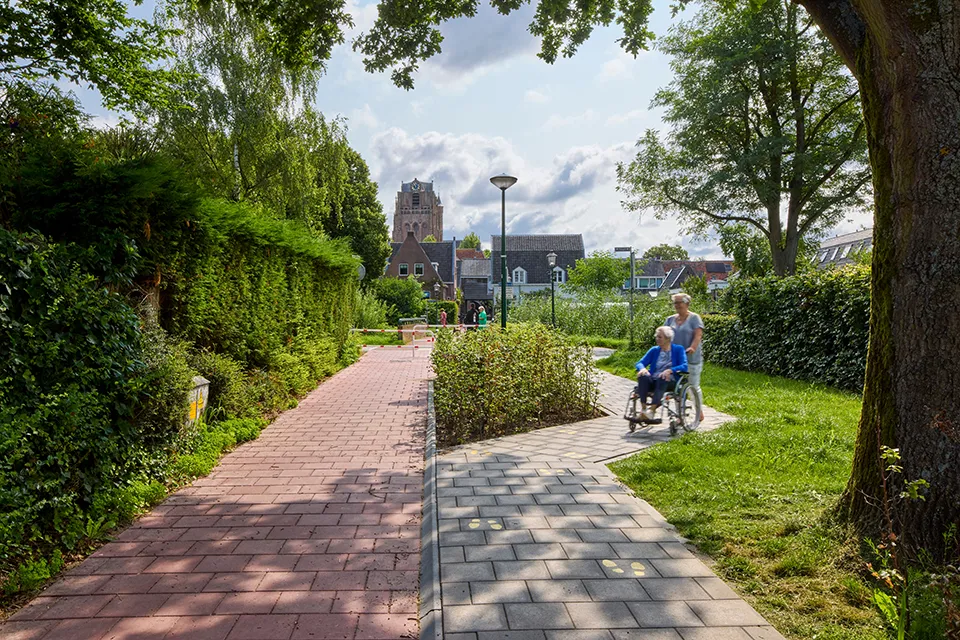
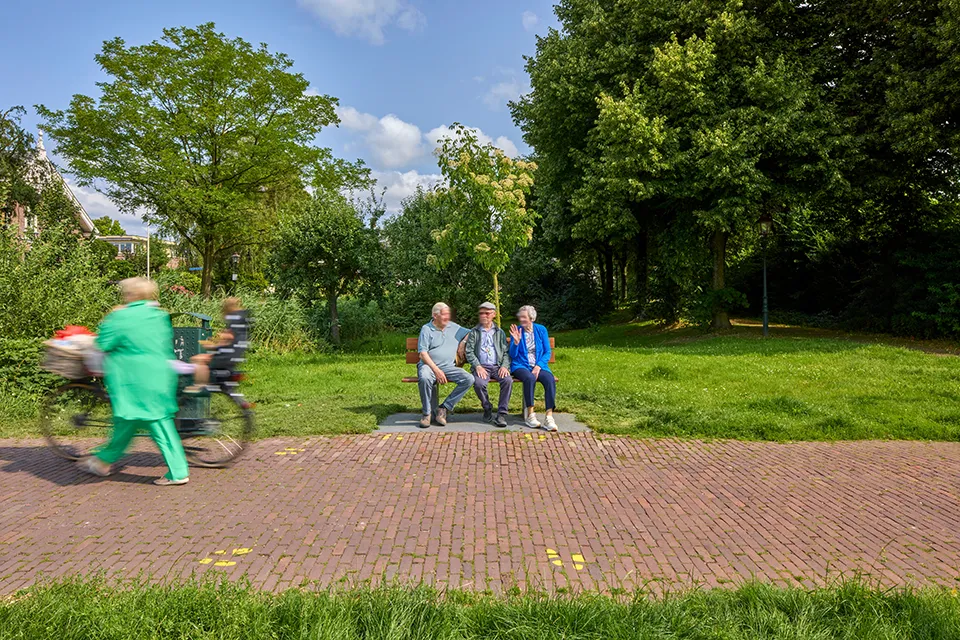
A bench has been installed at the end of the route, giving residents a place to rest along the way. From there, they can continue to the town centre or return home. The benches have been positioned with the average distance older people can walk at a time in mind. Dirks: “As well as installing a new bench, we also adapted existing street furniture. Lampposts standing in the middle of the pavement were moved because it was difficult for people to pass each other, and impossible for someone using a walking frame. Coloured paving slabs also make the distinction between the footpath and cycle path clearer, and part of the footpath has been rerouted to make it less convenient for cyclists to use as a shortcut. Working with the municipality, we turned the recommendations and design proposals into a detailed plan, which was implemented shortly afterwards.”
The exercise garden next to Ewoud & Elisabeth Gasthuis has also been redesigned, as people with dementia and impaired vision may experience empty planting beds as a frightening black void.
Two routes
Studio id+ developed two routes: one to the town centre and one in the immediate vicinity of Ewoud & Elisabeth Gasthuis. The first route was opened as a pilot on 24 April 2024, during the first Wijkse Wandel3daagse for older people. With no fewer than two hundred participants, it was a great success. Based on the pilot’s findings, the second route will be completed later this year.
Question about this story? Ask your question
Keep following this
Get an email when a new story is published. No account needed.
- SubjectResidential care & nursing homes