Academics discuss future of healthcare with Minister Hermans: steer towards shared health goals
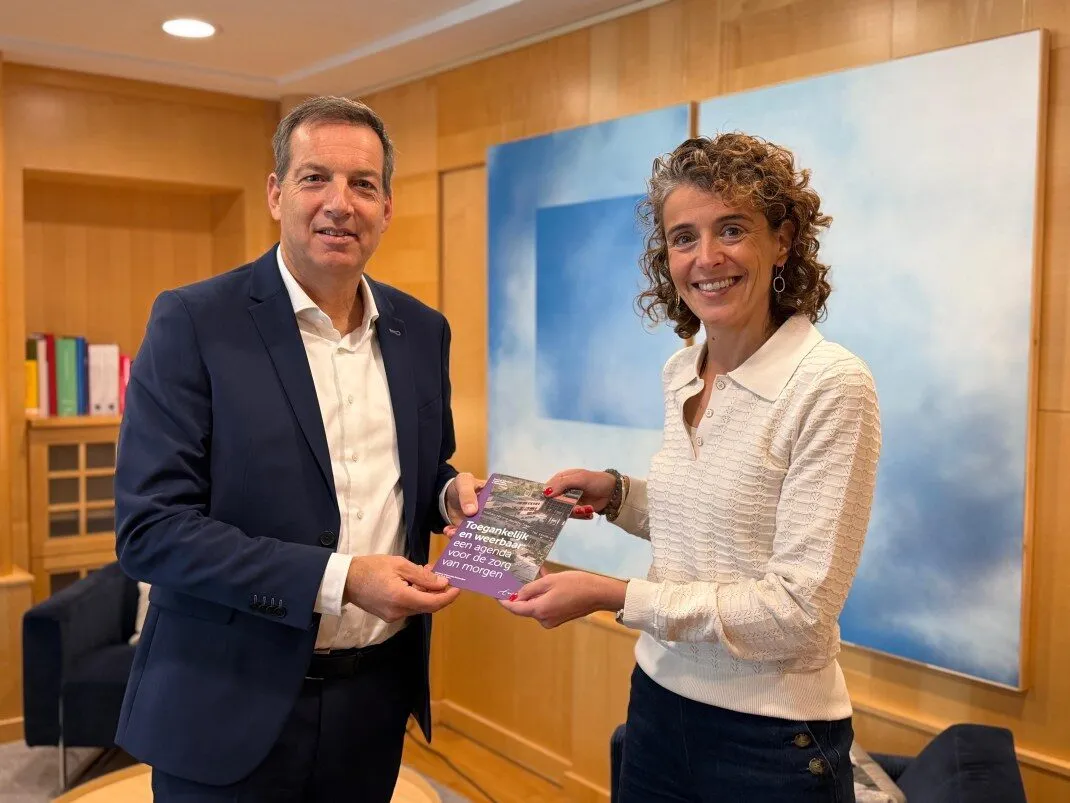
Almost 25 years after its earlier manifesto on the healthcare system, Erasmus School of Health Policy & Management (ESHPM) is presenting its new agenda for the healthcare of tomorrow to Minister Sophie Hermans. Among other things, the researchers argue for national and regional health goals and a different approach to financing and organising care.
How do we keep Dutch healthcare accessible and resilient while demand for care is growing, staff are scarce and health inequalities are proving persistent? That question is central to the new agenda Accessible and resilient: an agenda for the healthcare of tomorrow from Erasmus School of Health Policy & Management (ESHPM). Maarten IJzerman, dean of ESHPM, and researchers presented the agenda to Sophie Hermans, Minister of Health, Welfare and Sport, in The Hague on Wednesday 25 November.
"Policymakers, academics and healthcare professionals often mean the same thing, but speak different languages. Universities must be involved in this public debate. ESHPM can bridge the gap by connecting the different worlds and separating fact from assumption. There is still a great deal we do not know, but that should not be a reason to avoid making policy choices, because at the same time there is also a great deal we do know." - Minister Hermans, VWS.
The healthcare system needs to be reoriented. The challenges have changed and call for choices that go beyond the organisation of individual care providers. ESHPM therefore wants to support the collaboration between parties that is needed to organise health and care in an integrated way.
"Since the Integraal Zorgakkoord (Integrated Care Agreement), a movement has been set in motion that is irreversible, but the willingness of some parties is reaching its limit. Separate legislative proposals and measures keep raising new questions, which slow things down or even bring us to a complete standstill. ESHPM can help safeguard the integrated approach and coherence. We help one another by jointly working out what a good first step towards integrated care looks like and which follow-up steps are logical after that." - Minister Hermans, VWS.
The agenda is in line with the move towards more integrated care, but also shows which changes in organisation and financing are needed to take that movement further.
From care services to health goals
One of the proposals in the agenda is to move from contracts focused mainly on individual care services and numbers of treatments to contracts focused on shared health goals in the region.
This requires different agreements between health insurers, municipalities and care organisations, as well as sufficient financial and legal scope to collaborate across the boundaries of healthcare and the social domain.
The agenda looks beyond healthcare itself. ESHPM argues for making health a core objective of government policy, with national health goals and responsibility for health across the entire cabinet.
"Care organisations are currently held to account mainly for their own performance, while people's health depends on what various parties do together. If we take collaboration and prevention seriously, we must also adapt the way we finance and account for care accordingly." Roland Bal, professor, ESHPM.
Science, policy and practice in dialogue
The agenda brings together 19 themes, divided over five chapters: from care to health, caring for care workers, sustainable care, the design of the healthcare landscape and appropriate governance.
The agenda also identifies bottlenecks in policy learning, such as fragmentation of knowledge and the lack of structural conditions to make changes last. Among other things, ESHPM argues for greater coherence in the knowledge infrastructure and for long-running programmes in which researchers, policymakers and healthcare professionals work together on shared issues.
"How do we organise and finance care that remains accessible, is used efficiently and meets what patients need? With this agenda we bring together insights from different research fields and show where change is needed. Not with a single blueprint, but with knowledge that helps to make well-founded choices and to keep care accessible, fair, patient-centred and resilient." - Maarten IJzerman, dean of ESHPM.
Download the agenda
The concise and full versions of Accessible and resilient: an agenda for the healthcare of tomorrow are available at: https://www.eur.nl/eshpm/over/agenda-voor-de-zorg
Erasmus School of Health Policy & Management (ESHPM) is a leading faculty for education and research in healthcare policy and management. ESHPM's strength lies in its multidisciplinary approach: under the banner of Sustainable Healthcare for All, researchers from a wide range of disciplines, including health economics, health law, organisational science, public administration and medical sociology, work closely together. In close coordination with societal partners, they focus on current and complex issues in healthcare. In this way, education and research remain not only academically strong, but also socially relevant and directly applicable in practice.
Question about this story? Ask your question
Keep following this
Get an email when a new story is published. No account needed.
- SubjectNews